
New Study Finds E-Cigarette Directory Laws Did Not Lead to Sustained Reductions in Sales of Flavored E-Cigarettes, Which Are Known to Appeal to Youth
Evaluation of directory laws finds no long-term impact on sales and mixed impact on product availability
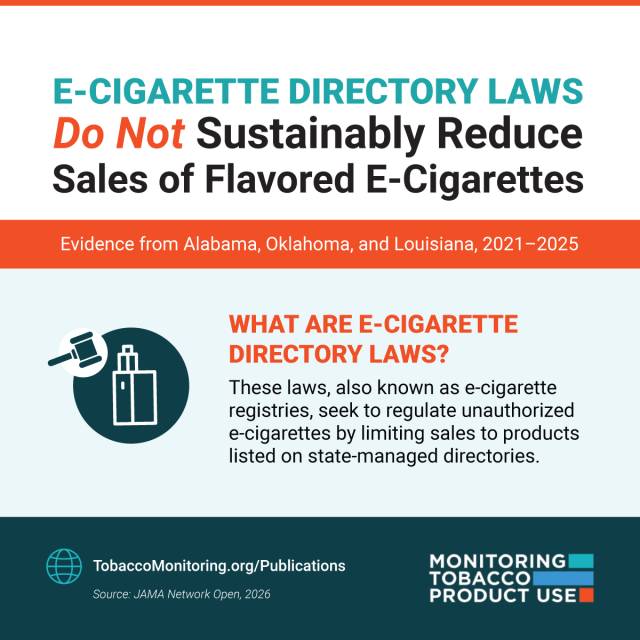
In a study published today in JAMA Network Open, researchers from the CDC Foundation found that e-cigarette directory laws, also known as e-cigarette registries, in Alabama, Oklahoma and Louisiana were not associated with sustained reductions in sales of flavored e-cigarettes. This is the first known study to rigorously evaluate the impact of e-cigarette directory laws on e-cigarette sales and product availability.
Researchers used retail scanner data* from January 2021 through April 2025 to examine changes in e-cigarette sales, measured by the total amount of nicotine sold per-capita and changes in the number of distinct e-cigarette products sold. The study used advanced evaluation methods to compare e-cigarette nicotine sales and product availability in the first three states to implement e-cigarette directories with similar states that did not enact directory laws.
In their evaluation, researchers found no significant effects on e-cigarette nicotine sales or product availability in Alabama or Oklahoma following implementation of directory laws. In Louisiana, sales and product availability declined following publication of the directory. However, sales in Louisiana rebounded within eight months and ultimately exceeded pre-directory levels, whereas the number of available products remains lower than before the policy was implemented.
The findings from Louisiana suggest declines in product availability do not necessarily translate into meaningful reductions in sales of flavored e-cigarettes, which are known appeal to youth. Menthol prefilled cartridge products and flavored disposable e-cigarettes that were not included in Louisiana’s directory drove the resurgence in sales. Evidence-based tobacco control strategies remain important tools for reducing tobacco and e-cigarette use and protecting youth from nicotine addiction.
By April 2025, more than half of per-capita e-cigarette nicotine sales in all three states came from products not listed on the state directories, as required by the states’ laws.
“These findings suggest e-cigarette directory laws as currently implemented are not sufficient to achieve sustained reductions in sales of flavored e-cigarettes,” said Rachna Chandora, MPH, chief program officer at the CDC Foundation. “As communities and states continue to tackle the issue of youth e-cigarette use, cutting-edge methods like those used in this evaluation can help uncover what works and what doesn’t to protect young people from nicotine addiction."
As of August 2026, the U.S. Food and Drug Administration (FDA) has authorized the sale of 45 e-cigarette products, most of them tobacco- or menthol-flavored. However, the U.S. market continues to be dominated by thousands of unauthorized flavored e-cigarette products. Currently, 17 states have enacted laws to establish public, state-managed e-cigarette directories intended to restrict the sale of unauthorized products. Most e-cigarette directories list products that may be sold in the state based on criteria established by state law. However, directories typically include numerous products that have not received marketing authorization from the FDA.
“This study underscores the importance of evaluating tobacco control policies in real-world settings,” said Fatma Romeh Ali, the study’s lead author and a health economist at the CDC Foundation. “Understanding how e-cigarette sales change over time in states with directory laws compared with similar states without such laws helps policymakers better understand both the immediate and lasting health impacts of these policies. The data and findings from studies like this one can help inform evidence-based decision making to reduce youth e-cigarette use across the United States.”
Since 2019, the CDC Foundation and its partners have conducted research on the impact of U.S. state and local tobacco control policies on tobacco product sales and use to inform efforts to protect children and teens from the harms of commercial tobacco products. Learn more about tobacco product sales data and trends across the United States at TobaccoMonitoring.org.
*Retail sales data from Circana are market-level representative for covered brick-and mortar retailers (e.g., food and grocery stores, drug stores/pharmacies, convenience stores, mass merchandisers, club stores, dollar stores and military stores/exchanges). Data do not include purchase age and are not representative of online sales or sales from tobacco or vape specialty stores. Data were analyzed by[NP3.1][SH3.2] the CDC Foundation.
Recent Press Releases
About the CDC Foundation
The CDC Foundation is an independent nonprofit authorized by Congress to mobilize philanthropic partners to support the public health system, including the U.S. Centers for Disease Control and Prevention (CDC), in preventing and responding to threats to health. In this role, we are focused on one priority: building catalytic, flexible and impactful partnerships—with corporations, philanthropies, individuals and organizations—to help improve the health and lives of people in all communities, everywhere. Follow the CDC Foundation on Facebook, LinkedIn and Instagram.