Racing Against the Clock: Three Steps to Improving Outbreak Response
When a disease outbreak occurs, every minute matters. The faster health officials can detect a potential threat, notify the right authorities and launch a coordinated, effective response, the better the chances of containing it before it spreads.
To help countries respond more rapidly to emerging health threats, the CDC Foundation has been working with Resolve to Save Lives (RTSL) and the U.S. Centers for Disease Control and Prevention (CDC) on an approach known as the 7-1-7 framework. Developed by RTSL, the 7-1-7 framework is designed to improve outbreak response through three clear performance targets: detecting the threat within seven days, notifying the appropriate health authority within one day and completing a set of early response steps within seven days.
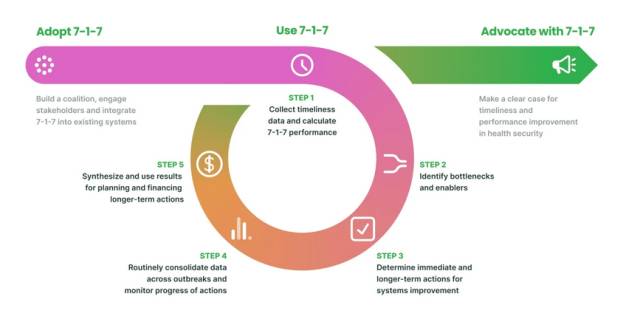
More than simply a set of targets, the 7-1-7 framework gives response teams a structured way to look at their own outbreak data, identify where delays are happening and develop concrete plans to address them. Currently adopted by more than 30 countries around the world and with over 50 countries in the planning stages of adoption, the 7-1-7 framework drew the attention of Mozambique’s Ministry of Health and National Institute of Health after recent outbreaks of cholera, Mpox and measles highlighted the urgency of this type of approach.
"The longer it takes to detect and respond to an outbreak, the faster it spreads,” said Lawrence Hinkle, a CDC Foundation consultant helping to train health professionals in Mozambique on the 7-1-7 framework. “In Mozambique, and in so many other countries adopting and implementing 7-1-7 to improve timeliness in detection, notification and response, we will hopefully be better equipped to stop outbreaks as they emerge."
Since January 2026, national, provincial and district level staff in Mozambique have been training on how to use the 7-1-7 framework to improve outbreak detection, notification and response. Each session combines instruction with hands-on exercises, providing teams the chance to perform a 7-1-7 analysis using real outbreak data, followed by facilitated discussions to help participants identify bottlenecks and prioritize immediate and longer-term actions.
“I’m learning a lot, and the exercises are helping to improve my training," said John João Anselmo, head of epidemiological surveillance for a district in the country’s Tete Province. “This has been one of the best trainings I’ve had.”
As Mozambique continues to face a range of public health challenges, embedding the 7-1-7 framework is a key step in improving the country’s capacity to prevent outbreaks from spreading. Extending to every level of the country’s public health network, the framework will help Mozambique’s public health workers more quickly detect the next outbreak, notify authorities and launch a response—ultimately saving lives.